
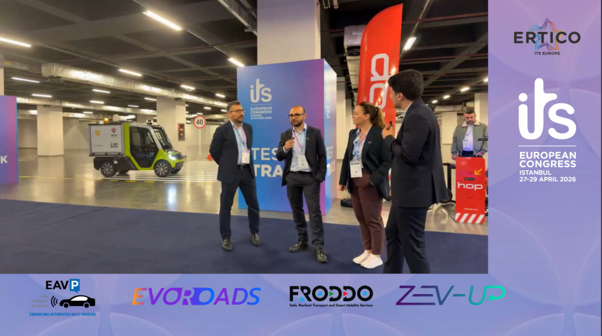
For those who did not have the opportunity to attend the ITS European Congress in Istanbul (27–29 April 2026), the webinar “The EU Projects behind the Demo Vehicles” offered a live window into the Demo Area on the opening day. Broadcast directly from the demonstration zone, the session was designed to showcase the European research projects behind the vehicles on display – including FRODDO – and explain how they collectively bring connected and automated mobility solutions to life during the Congress.
FRODDO – “Federated cybeR-physical infrastructure for ODD cOntinuity” – is a Horizon Europe project that focuses on making Operational Design Domains (ODDs) more robust, adaptive and safe in complex urban environments. Its vision is a future of secure, seamless connectivity and automation that can adapt to physical, technological and social challenges, supporting user-centric mobility and resilient transport systems. Rather than looking only at the vehicle, FRODDO brings road authorities, operators, digital infrastructure and vehicles together into a federated cyber-physical ecosystem.
From research to demo vehicles in Istanbul
The ITS European Congress demonstrations are designed to bridge the gap between research and deployment, showing how project results behave in real traffic conditions and mixed mobility settings. In this context, the webinar “The EU Projects behind the Demo Vehicles” highlighted how projects like EvoRoads, FRODDO and ZEV-UP, together with the ERTICO EAVP platform, jointly underpin the live demonstrations on the test track and exhibition floor.
During the session, FRODDO’s contribution can be understood in three steps:
- Understanding the operational context. FRODDO starts from the premise that the operational context – road geometry, weather, traffic, vulnerable road users and infrastructure – is central to CCAM performance and safety. By formally describing ODDs and their boundaries, the project helps authorities and operators assess where and how automated services can safely operate.
- Building a federated Digital Twin for transport. FRODDO develops a secured, federated Digital Twin platform that fuses data from vehicles, roadside infrastructure, traffic management systems and the wider urban environment. This platform allows traffic managers and road operators to visualise real-time conditions, simulate CCAM strategies and coordinate responses to incidents around the demo vehicles.
- Validating solutions through pilots and demonstrations. The project tests its methods in four pilot sites – Ljubljana, Athens, Modena and Bursa – covering multimodal user interfaces in automated shuttles, enhanced positioning and navigation in complex geometries, infrastructure-enabled awareness at intersections, and cost-effective alternatives to GNSS for autonomous logistics. These pilots provide the foundation for showing at events like ITS European Congress how CCAM services can be scaled and replicated under different local conditions.
How FRODDO supports safer, smarter and more resilient mobility
Behind every demo vehicle at ITS European Congress is a chain of decisions about infrastructure, connectivity, data and safety – and this is exactly where FRODDO’s work packages come into play.
- Cooperation framework of CCAM actors (WP2): FRODDO defines how authorities, operators, industry, and citizens collaborate, specifying safe interaction mechanisms between automated vehicles and users, and creating frameworks for service readiness, scalability and fair data governance. These cooperation models ensure that what visitors see on the demo track reflects robust processes behind the scenes.
- Next-generation cyber-physical infrastructure (WP3): The project revisits road design principles, positioning and communication protocols to enhance ODD continuity, including advanced GNSS/5G-based positioning and secure C-ITS communication. This helps ensure that the demo vehicles can maintain reliable awareness and connectivity even in challenging environments.
- Federated Digital Twins for road transport (WP4): FRODDO’s Digital Twin platform combines integrated services, AI-enhanced traffic management, alerting and decision support dashboards, giving operators a holistic view of CCAM operations. This federated approach to the Physical and Digital Infrastructure (PDI) enables seamless integration of CCAM technologies across urban areas – a capability already highlighted by the project’s previous participation in ITS World Congress 2025.
Why this matters for cities and road operators
For cities and road operators, demo vehicles at ITS European Congress are more than showcase pieces – they are early glimpses of how future mobility services might work in their streets. FRODDO contributes by:
- Providing design guides and validation frameworks for infrastructure and positioning solutions, so that authorities can confidently plan CCAM-ready corridors and junctions.
- Offering Digital Twin-based tools that translate complex sensing and AI outputs into intuitive dashboards for traffic controllers and decision-makers.
- Developing governance and business models that consider legal, ethical, data security and standardisation aspects, helping ensure that CCAM deployments remain compliant, trusted and economically sustainable over time.
By bringing these elements together, FRODDO supports a move from isolated demonstrations toward scalable, interoperable CCAM services that can be replicated and extended beyond the test track.
Watch the session and follow FRODDO’s journey
The recording of “The EU Projects behind the Demo Vehicles” from the ITS European Congress 2026 is available online, offering a behind-the-scenes look at how EU-funded projects like FRODDO shape the demo programme and contribute to Europe’s CCAM roadmap. Combined with the project’s growing portfolio of publications, events and blog posts, this webinar is a key resource for stakeholders interested in the practical steps from research to deployment.
As FRODDO continues its pilots in Ljubljana, Athens, Modena and Bursa and progresses toward its final Digital Twin and governance outcomes, future blog posts will further explore how these results can be transferred to other cities, regions and industrial applications. Through this ongoing blog series, the consortium aims to share lessons learned, good practices and tangible pathways towards safer, smarter and more resilient mobility across Europe.
Authors: George Christou (ERTICO)